Integrals
∫ xⁿ dx = xⁿ⁺¹ / (n+1) + C
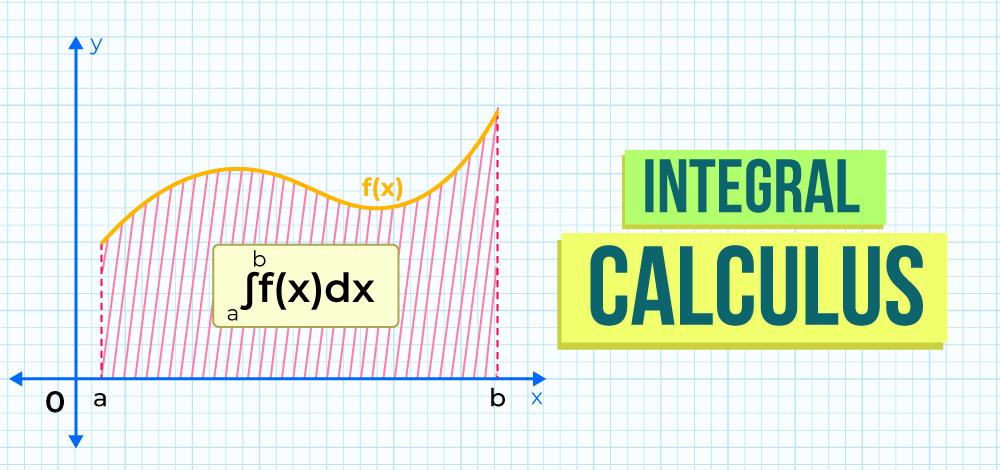
An integral represents accumulation, total change, or area under a curve. It is the inverse operation of differentiation. There are two main types of integrals: indefinite integrals and definite integrals. An indefinite integral gives a family of functions and includes a constant of integration. A definite integral calculates a numerical value that represents the area between a function and the x-axis over a specific interval. Integrals are used to compute total distance traveled when velocity is known. In physics, they help calculate work, energy, and mass. In probability theory, integrals are used to determine probabilities from density functions. Geometrically, they allow us to compute areas and volumes of irregular shapes. The connection between derivatives and integrals is explained by the Fundamental Theorem of Calculus, which shows that they are inverse processes. Integrals are essential for modeling cumulative effects in real-world situations.