INTRODUCTION
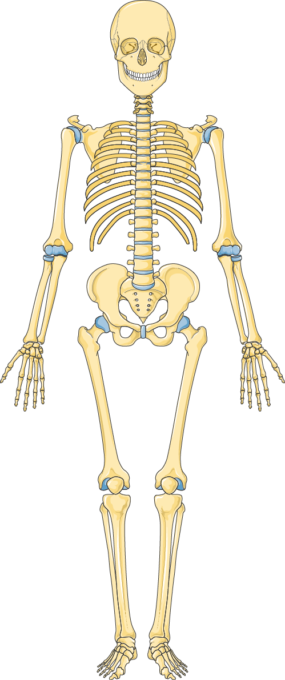
Movement is achieved through the skeletal system - the passive part and the muscular system - the active part of the locomotor system. The totality of bones connected to each other by joints forms the skeleton of the body which comprises over 200 bones.
THE SKELETON. STRUCTURE
According to the regions of the body, the following are distinguished: the skeleton of the head, the skeleton of the trunk and the skeleton of the upper and lower limbs
1. THE SKELETON OF THE HEADis made up of 22 bones and includes: the neurocranium, the viscerocranium
a) The neurocranium - the cranial box, made up of 8 wide bones that house the brain, of which:
• 4 unpaired: - the frontal bone (forehead bone); - the ethmoid and sphenoid bones located at the base of the cranial box; - the occipital bone (neck bone);
• 2 pairs: - the temporal bones (temple bones); - parietal bones (cranial vault bones)
b) Viscerocranium - consists of 14 bones of which:
• 2 unpaired bones: vomer bone, lower jaw bone - mandible;
• 6 paired bones: - maxillary bones; - palatine bones; - nasal bones; - lacrimal bones; - zygomatic bones; - inferior nasal turbinate bones
Types of bones:
- Long bones – femur, humerus
- Short bones – carpals, tarsals
- Broad bones – skull, sternum, scapula
- Irregular bones – vertebrae
- Sesamoid bones – patella
Bones have different shapes depending on the role they play in the body. Their shape is adapted for support, protection or movement. Together, they make up the skeleton that provides structure and stability to the human body.

2. THE SKELETON OF THE TORSO
The skeleton of the trunk includes: the spine, the ribs, and the sternum.
a) The spinal column is made up of 33-34 vertebrae articulated by intervertebral discs
It comprises 5 regions:
- cervical, made up of 7 vertebrae
- thoracic, made up of 12 vertebrae
- lumbar, made up of 5 vertebrae
- sacral, made up of 5 vertebrae
- coccygeal, made up of 4-5 reduced vertebrae
It has 4 physiological curvatures:
- cervical lordosis and lumbar lordosis, with convexity disposed posteriorly
- thoracic kyphosis and sacral kyphosis, with concavity disposed posteriorly
b) The ribs are 12 pairs in number, they are wide bones and are divided into:
- true ribs - the first 7 pairs from I-VII which are articulate directly with the sternum through their own costal cartilages
- false ribs - the next 3 pairs VIIl-X which articulate indirectly with the sternum through the cartilage of the 7th rib
- floating - the last 2 pairs XI-XII which do not articulate with the sternum
c) Sternum
- the breastbone
- formed by the body, manubrium and xiphoid process
- articulates with the clavicles and the first 7 pairs of ribs
The sternum, ribs and thoracic region of the spine form the rib cage.
3. THE SKELETON OF THE LIMBS
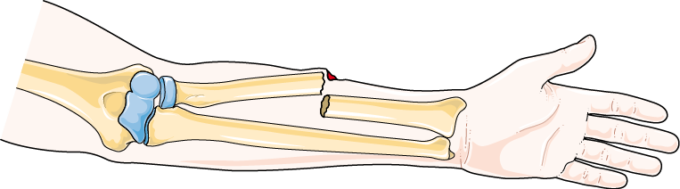
The skeleton of the limbs is formed by the skeleton of the belts and the skeleton of the limbs themselves.
a) The skeleton of the upper limbs comprises:
• the shoulder girdle that connects the bones of the upper limbs to the skeleton of the trunk and is formed by: - shoulder blade; - scapula; - clavicle.
• the skeleton of the free limb itself formed by:
- the skeleton of the arm - humerus
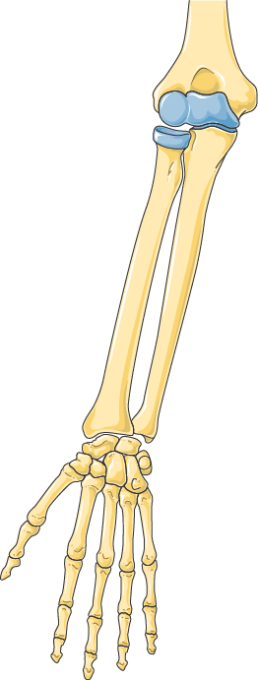
- the skeleton of the forearm - radius
- the skeleton of the hand - carpus (made up of 8 carpals, 5 metacarpals and 14 phalanges)
b) The skeleton of the lower limbs comprises:
• the pelvic girdle that connects the skeleton of the lower limb to that of the trunk and is formed by:
- 2 coxal bones, which together with the sacrum and coccyx form the pelvis
• the skeleton of the free limb itself formed by:
- the skeleton of the thigh - femur
- the skeleton of the lower leg - tibia and fibula (fibula)
- the skeleton of the foot (7 tarsals, 5 metatarsals and 14 phalanges)
- the kneecap (patella) the knee bone
THE ROLE OF THE SKELETAL SYSTEM

The skeletal system performs important functions for the life of the organism:
• ensures the bipedal position of the human being
• gives the body its characteristic shape
• represents insertion sites for muscles
• forms protective cavities: ⁃ the cranial box, houses the brain; - the vertebral canal, houses the spinal cord; - the thoracic box, houses the heart, lungs, and large vessels; - the pelvis houses organs of the digestive, excretory, and reproductive systems
• constitutes a deposit of mineral salts
• through the red marrow contributes to the formation of the figured elements of the blood
• the bones represent the levers that play a role in movement
THE STRUCTURE OF A BONE
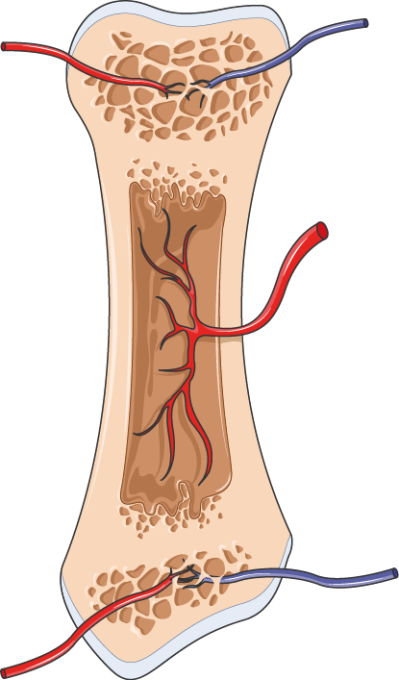
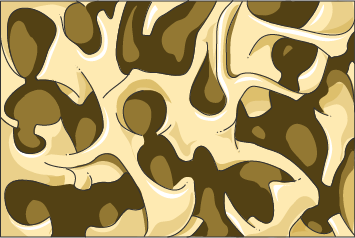
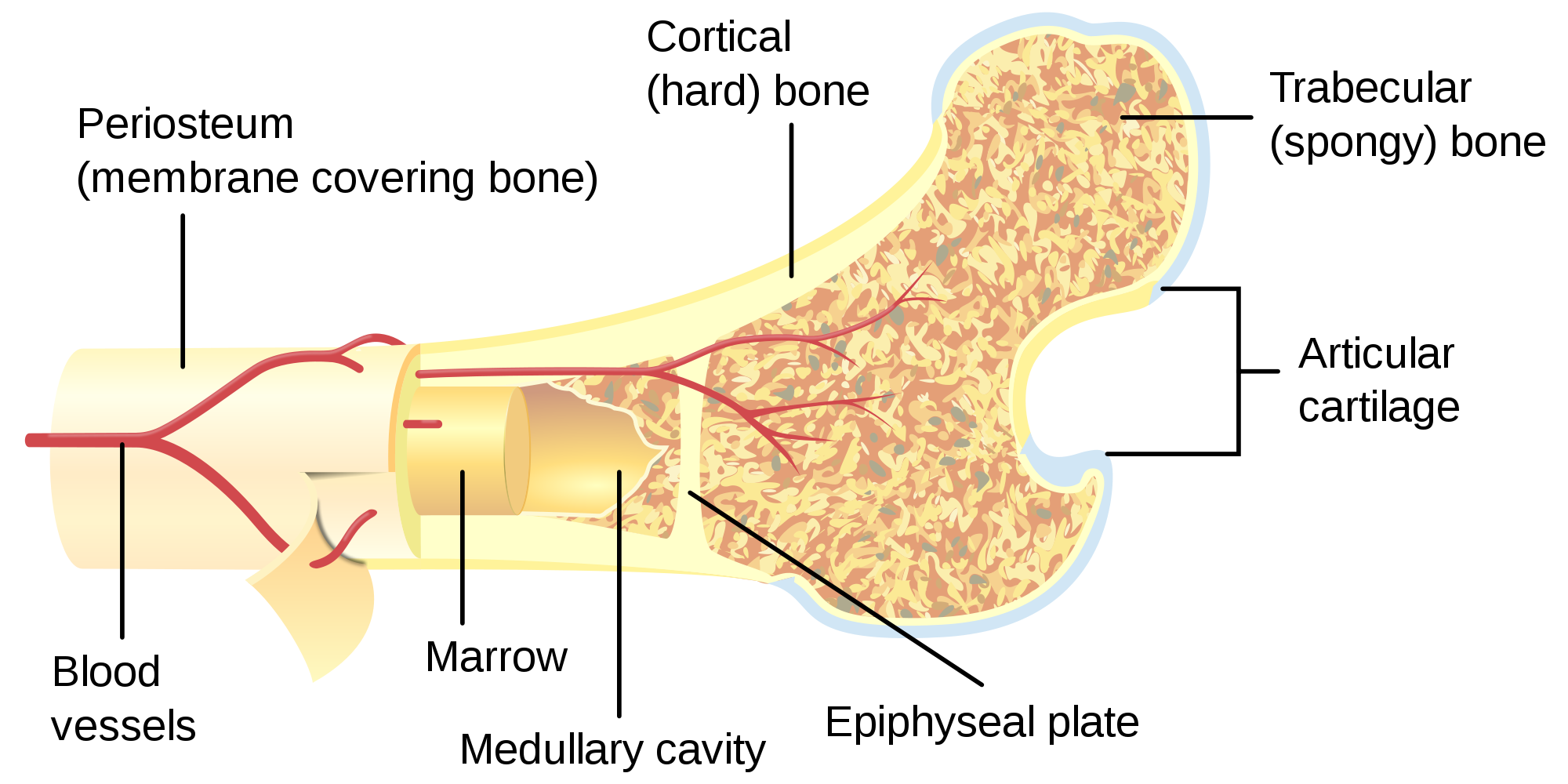
A bone is made up of several components that give it strength and flexibility. On the outside is the periosteum, a protective membrane richly vascularized. Underneath it is the compact bone tissue, which is hard and resistant, and on the inside is the spongy bone tissue, which has a porous appearance.
THE JOINTS
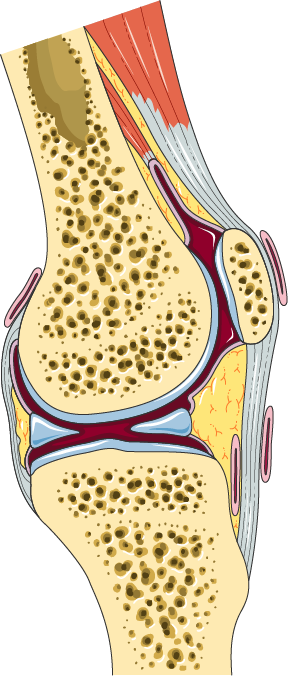
Joints are the connections between two or more bones. They allow movement of the body and provide flexibility to the skeleton.
THE HUMAN SKELETON