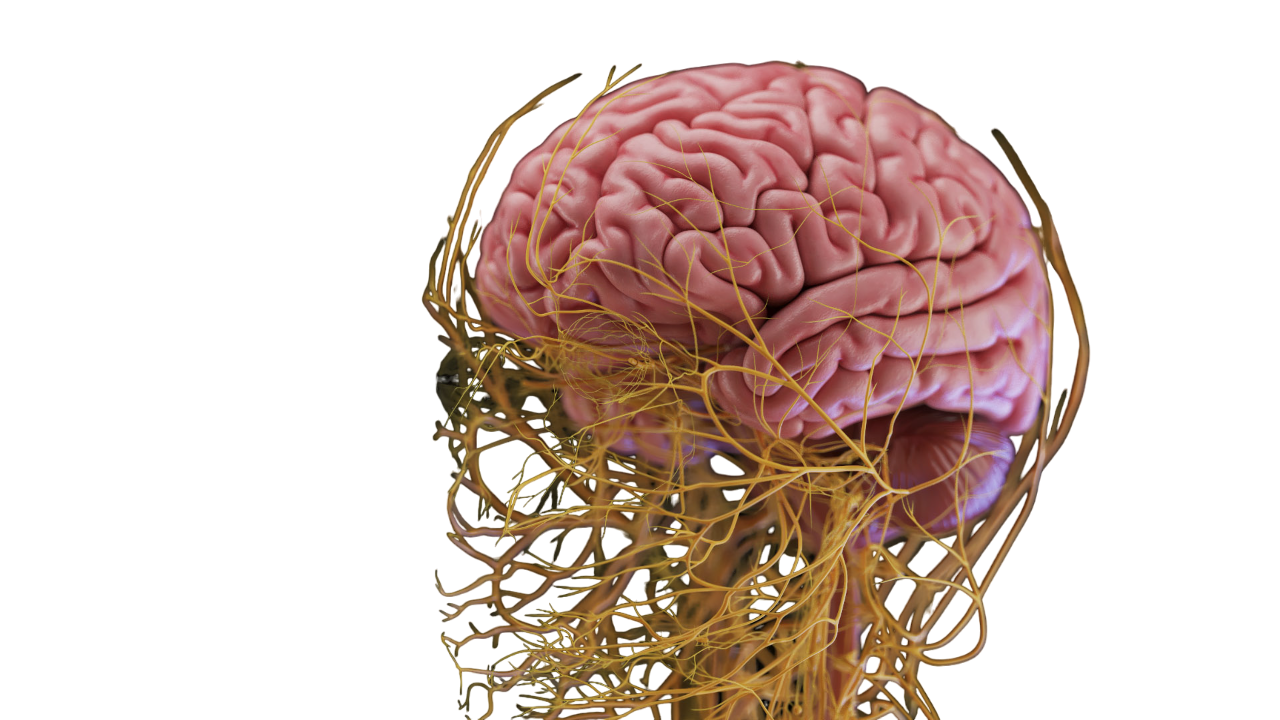
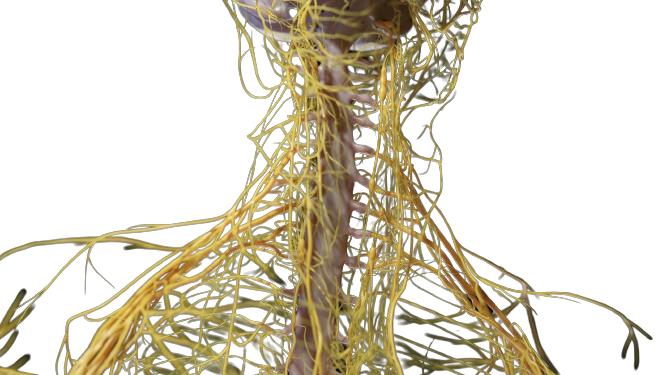
The nervous system coordinates the body's activities through messages called nerve impulses, ensuring adaptation to changes in the environment.
The nervous system is made up of nerve organs. Nerve organs are made up of nerve tissue, but also connective tissue and blood vessels.
DISCOVER MORE
NEURON
Neurons are formed from the cell body and neural prolongations (dendrites and axon). The cell body (neuronal) consists of membrane, cytoplasm and nucleus. Dendrites are numerous in most neurons and conduct nerve impulses to the neural body. The axon is unique, longer than dendrites from most neurons, and it conducts impulses from the neural body to other cells. The axon can be covered by sheaths (for example, the myelin sheath) and has a terminal branching with buttons containing vesicles with chemical mediators.
BRAIN
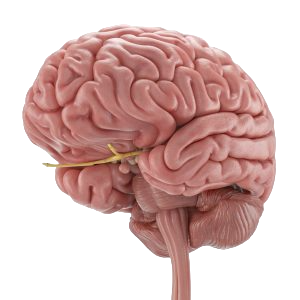
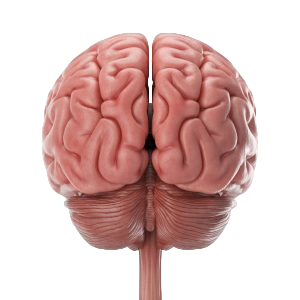
The brain is a central nervous organ located in the cranial box. It consists of the large brain, cerebellum and brain stem. Each component has a different composition and specific functions, but it is connected with the other components of the central nervous system. The human brain has a mass of about 1400 grams.
CLASSIFICATION OF THE NERVOUS SYSTEM
The nervous system can be classified according to two criteria.
By location, the nervous system is classified as:
- the central nervous system (CNS) consists of the encephal (brain) and spinal cord;
- the peripheral nervous system (PNS) consists of nerves (cranial and spinal) and nerve ganglia.
By role, the nervous system can be classified as:
- the somatic nervous system that connects the body with the living environment, controlling the activity of skeletal muscles;
- the vegetative nervous system that controls the internal organs, adapting their work to ordinary situations.
REMEMBER!
The nervous system consists of nerve organs, grouped by location in the central nervous system (formed by the brain and spinal cord) and peripheral nervous system (formed by nerves and nerve ganglia).