Main parts of the camera
1. The camera obscura can be defined as a mechanical copy of the eye. By analogy, the camera obscura is similar to the human eye, consisting of a parallelepiped box with a black interior (eyeball), with a very small opening. On the wall opposite the opening there is a translucent screen on which the image of the object is formed, real, smaller than the object and turned upside down.
2. Fixed
focal length lens
Macro lens - lens with a short focal length of 20, 30, 40 mm.
Normal focal length (standard) 50mm lens. The lens "sees" like a human eye.
Telephoto lens - lens with a long focal length greater than 50 mm.
The variable focal length lens is called zoom. It is composed of a convergent and a divergent lens, located at a certain distance, d. By changing the distance between the two lenses, the focal length (f) of the system is changed and, implicitly, the image size changes.

3. The variable aperture controls the aperture of the lens and determines the amount of light that reaches the film.
4. The shutter adjusts the shutter speed. The camera's shutter system provides light control to the image sensor (or to film, in the case of the classic camera)
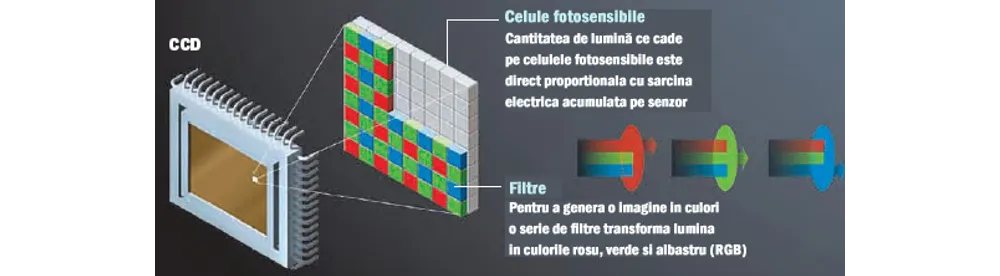
5. Photo film (for analog camera) or CCD detector with memory card (for digital camera).
 6. The aiming system allows control of the framing of the subject of the photo. It also helps to control the sharpness of the image.
The digital camera has a lot in common with the classic camera (with film). Use lenses, shutter systems, viewfinders and focus systems. It differs in the way it captures, memorizes and processes photographic images. They use image sensors for the initial memory of the image.
6. The aiming system allows control of the framing of the subject of the photo. It also helps to control the sharpness of the image.
The digital camera has a lot in common with the classic camera (with film). Use lenses, shutter systems, viewfinders and focus systems. It differs in the way it captures, memorizes and processes photographic images. They use image sensors for the initial memory of the image.
The image sensor transforms the image into an electrical signal, which is then transformed into a digital signal, through which the information is stored on a storage medium (memory card).
The image sensor works together with an image processor. The latter takes the analog signal from the image sensor, transforms it into a digital signal (in bits - strings of 0 and 1). The digital signal, which carries the information about the image captured with the camera, is then stored on a memory card.
 The digital image is made up of square elements called pixels ("the pixels" of the classic image, made on film, are the silver grains).
The pixels are the same size, but can have different color values.
Digital photos are made up of hundreds of thousands or millions of pixels. A pixel is a small square that has a certain color.
If we enlarge an image a lot, we will notice the colored pixels in the three primary colors in optics (red, green and blue).
The quality of an image depends largely on the resolution (the number of pixels in the image). If the image has a high resolution, then details and contours will be perceived much better than in a low-resolution image.
The number of pixels of the camera is given by the camera's image sensor.
The dimensions of a digital image can be expressed in two ways.
In the first way we refer to the number of pixels on the length and width, for example 6000 x 4000, where the first digit indicates that the length of the image is 6000 pixels and the second digit refers to the width of the image.
The second option is to multiply the dimensions and thus we get the total number of pixels in the image 24,000,000 pixels (6000 ∙ 4000), i.e. 24 mega pixels (24 ∙ 106 pixels).
Problem solved
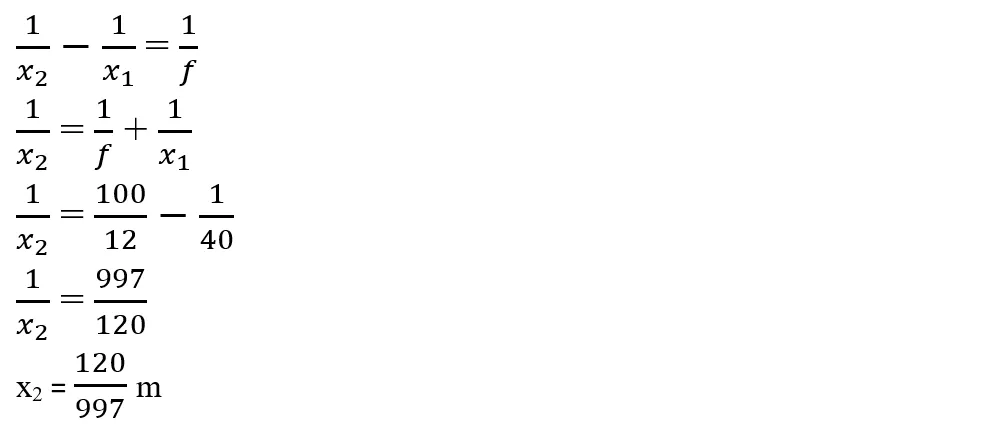
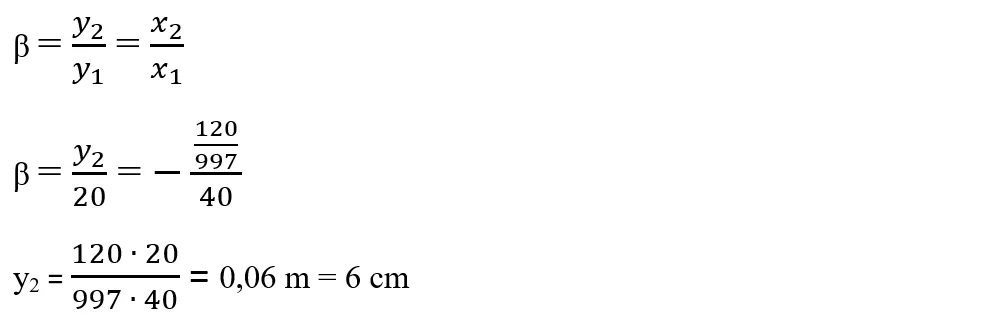
1. A photographer is at a distance of 40 m from a building with a height of 20 m. The camera lens has a focal length of 120 mm. How tall will the image of this building be on the photo film?
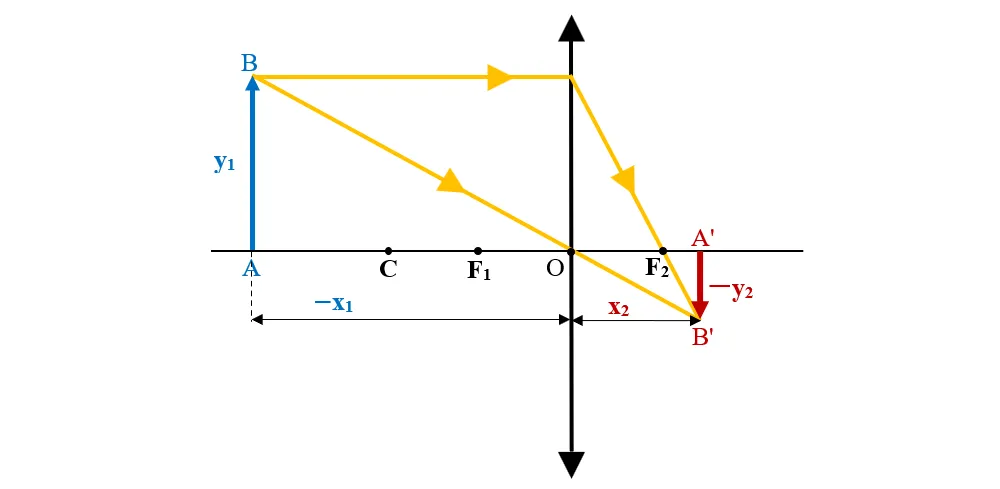 Solution:
We write down the data of the problem (we take into account the sign conventions) and transform them into SI:
x1 = - 40 m
y1 = 20 m
f = 120 mm = 12/100 m
y2 = ?