Light Scattering
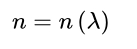
Light dispersion is the phenomenon of the refraction of white light into differently colored light beams. These colors make up the spectrum of white light and are: red, orange, yellow, green, blue, indigo and violet. It consists in the variation of the refractive index n of a substance according to the wavelength 𝜆
The mathematical relationship for dispersion is:
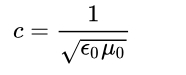
Vacuum is non-dispersive. For a vacuum, the electromagnetic wave propagation speed is constant:
For some environment:
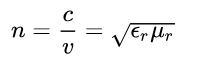
A particular case of light scattering is the phenomenon of the refraction of white light into differently colored light beams. These colors make up the spectrum of white light and are: red, orange, yellow, green, blue, indigo and violet.
Explanation of the phenomenon
The light from the sun is white. Isaac Newton discovered 300 years ago, with the help of a prism, that white light consists of several differently colored beams. The optical prism is a homogeneous and transparent medium, bounded by two flat and non-parallel faces. When passing through the prism, the light splits into colored beams. The colored beams pass through the prism at different speeds, so they exit the prism at different angles.
Optical Prism
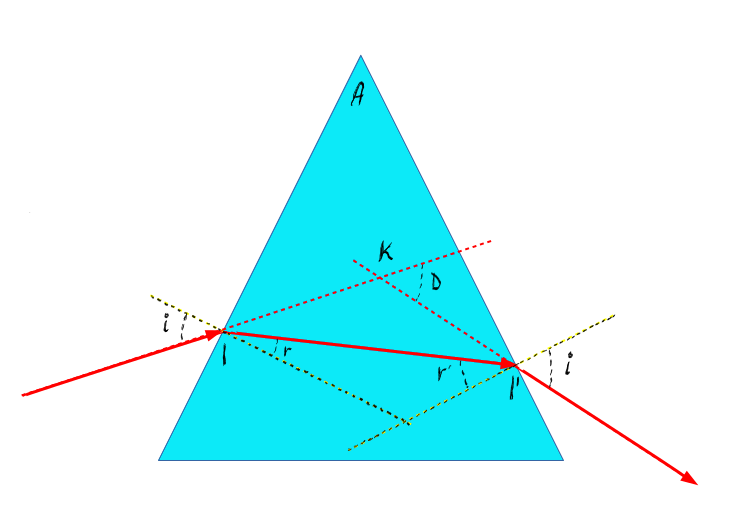
The optical prism is a body in the shape of a right triangular prism, made of transparent material (usually glass).
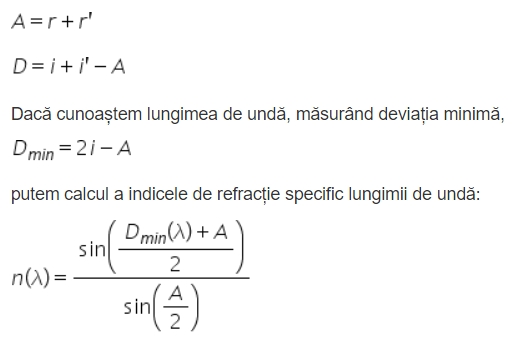
The cross section of the optical prism is a triangle. The prism has a vertex marked A and a base. Looking at the body of the prism as a whole, the apex of the prism is the dihedral angle formed by two faces of the prism (the one through which the light enters and the one through which the light exits).
The angle formed by the direction of the incident ray and the direction of the emergent ray (the ray coming out of the prism), is called the angle of deviation or the deviation of the prism and is denoted by D.
Dispersion properties
When the refractive index decreases with decreasing wavelength of electromagnetic radiation we say that we have normal dispersion.If the refractive index increases with increasing wavelength in the range 450 - 570 nm (blue - green) and decreases with increasing wavelength in the range 570 - 750 nm, we say that we have anomalous dispersion.
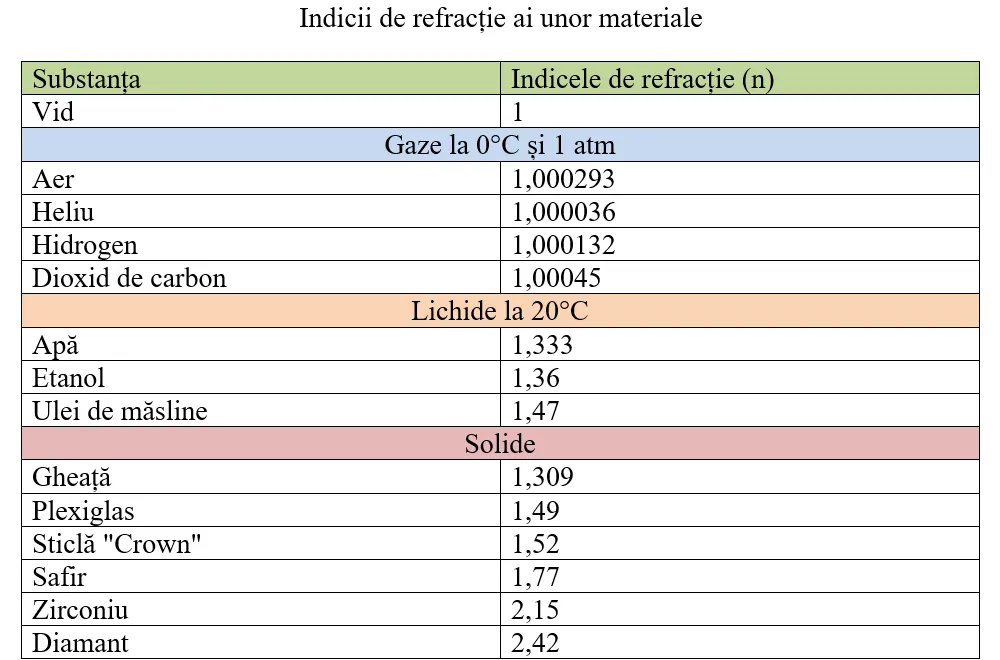
But the refractive index is constant only for monochromatic light.
For white light, made up of seven rays of different colors and different wavelengths, the refractive index is no longer constant, but varies with the wavelength of these lights.
If the refractive index of a prism varies, the prism will refract these lights at different angles.
In general, with normal diffusion, in these transparent media the refractive index increases with decreasing wavelength, thus violet rays (having a shorter wavelength, 400 nm) will be refracted more strongly than red ones (with a longer wavelength high, 700 nm, than the violet ones).
If λviolet < λred → nviolet > nred → vviolet < vred.
The colored beams pass through the prism at different speeds and therefore exit the prism at different angles.
Violet rays emerge less inclined to the optical axis because they propagate at a slower speed through the prism material than the red ray, while traveling a shorter distance than the red